


In February and March, the Trump Administration made headlines with a series of executive orders and policy announcements. Among the most prominent was President Trump's threat to impose new tariffs on many countries who are the United States’ trade partners. On April 2, he followed through, announcing sweeping tariffs affecting the majority of these countries. Around the same time, the Department of Government Efficiency (DOGE) released a set of recommendations aimed at reducing federal spending across various sectors. In this article, we take a nonpartisan approach to examining these developments. By presenting the underlying data, we aim to equip you with the facts so you can make your own informed decisions.
In this blog, we will discuss:
- The U.S. Trade Deficit with Other Countries
- New Tariffs Announced by President Trump
- The Federal Deficit
- Cutting Government Spending
- Key Takeaways
Sign up for our email newsletter for views of the economy, stock market, and top news stories from our Wealth Managers at Financial Journey Partners.
The U.S. Trade Deficit with Other Countries
Let's start by looking at the trade deficit the U.S. has with all of the other countries.

Source: Bureau of Economic Analysis, YCharts
The graph above shows that during President Trump's first term (2016–2020), the U.S. trade deficit averaged around $50 billion per month. By the latter part of the Biden administration (2022–2024), that figure had grown to approximately $75 billion per month — an increase of about 50%. President Trump has stated that one of his key goals is to reduce the overall size of the trade deficit. On the other hand, imports have surged in the past few months (shown on the right of the graph above) as U.S. companies increase imports to build inventory ahead of the tariffs.
New Tariffs Announced by President Trump
On Wednesday, April 2, President Trump announced a new wave of tariffs on U.S. trading partners around the world. A baseline tariff of 10% will now apply to all imports into the U.S., with additional tariffs targeting approximately 60 countries that maintain the largest trade imbalances with the United States.
“For years, hard-working American citizens were forced to sit on the sidelines as other nations got rich and powerful—much of it at our expense. But now it’s our turn to prosper,” President Trump stated during his speech at the White House.
President Trump went on to explain that the new U.S. tariff structure will take into account not only traditional tariffs but also currency manipulation and non-tariff barriers. Below is a summary of key details:
- Effective April 5, a baseline 10% tariff will be imposed on all goods imported into the United States
- Starting April 9, higher, country-specific tariffs will be implemented, giving trading partners a short window of time to respond
- Six countries or regions - the European Union, Mexico, China, Canada, Japan and South Korea - will bear approximately 70% of the total tariff burden
- The executive order includes flexibility to reduce penalties if trading partners take meaningful steps to address U.S. concerns
- Key exemptions apply to certain goods, including energy, copper, pharmaceuticals, semiconductors, lumber and critical minerals not available domestically
- Steel and aluminum are not subject to these new tariffs, as they are already covered under existing measures
- Canada and Mexico are subject to their own previously announced tariffs
- Retaliations began on April 4, with China announcing a 34% tariff on all goods imported from the U.S. We anticipate other countries and regions could announce their own retaliatory tariffs soon.
We view this sweeping tariff policy as one of the most significant—and potentially risky—economic decisions made by a U.S. president in our lifetime.
What Could Happen If the Policy Fails:
- Rising prices on imported goods could strain consumer budgets
- Higher costs may fuel broader inflation across the economy
- Reduced consumer spending due to higher prices could slow economic growth
- Retaliatory measures from other nations may harm U.S. exports and global trade relationships
- A prolonged slowdown in spending and investment could potentially push the U.S. into recession
- Markets across the world are already reacting negatively
What Could Happen if the Policy Succeeds:
- Manufacturing could return to the U.S. as companies reconsider global supply chains
- Domestic job growth could accelerate, particularly in industrial sectors
- Business investment may rise, with several major companies already announcing new U.S.-based projects
- As the U.S. is a net importer, other countries may reduce or eliminate tariffs on American-made goods in response to U.S. concessions, creating more balanced trade
- Markets could turn around as things improve
Rather than producing purely negative or positive outcomes, the reality is likely to land somewhere in the middle. Over the next year, we’ll begin to see which of these potential outcomes materialize. The full impact of these tariffs will take time to unfold—and their success or failure could significantly influence the results of the 2026 midterm elections.
Given the scale of this policy shift, we expect 2025 to be a very volatile year for the markets. We are closely monitoring economic developments, market movements, and policy shifts—and we continue to adjust client portfolios as needed to navigate this evolving landscape.
The Federal Deficit
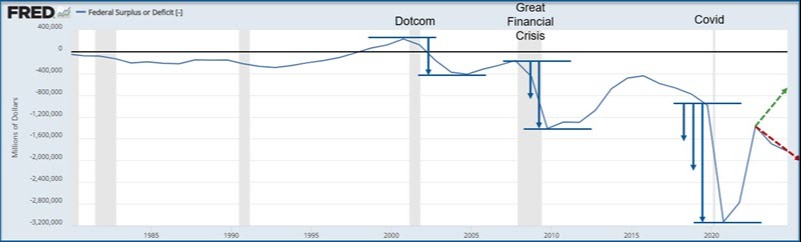
In our view, the federal government has a spending problem, the graph below makes this point clearly. You can learn more about the federal deficit in our recent blog on this topic. When we speak with clients, there’s broad agreement that federal operations could be more efficient—and that there’s ample opportunity to reduce wasteful spending.
Source: Federal Reserve Bank of St Louis
The graph above illustrates the federal budget deficit, with any amount falling below the zero line representing a deficit. Each downward arrow indicates a period of increased government spending during major crises over the past 25 years or so. In each case, spending was ramped up to support the economy and provide relief to Americans in need.
What’s especially notable is the growing size of these spending increases—each crisis brought a larger fiscal response than the one before. The arrows help visualize how federal spending has scaled upward with each new challenge.
In contrast, you’ll notice a green upward arrow for 2023 and 2024. Many leading economists had predicted that, as the economy recovered from the COVID-19 pandemic, the federal deficit would naturally shrink. Instead, the opposite occurred: a red downward arrow indicates that government spending increased, even amid an improving economy. This unexpected rise in spending contributed to a widening deficit in both 2023 and 2024.
Cutting Federal Spending
In an effort to reduce federal spending, President Trump established the Department of Government Efficiency (DOGE), appointing Elon Musk as its leader. The approach and methods employed by Musk, his team, and DOGE have sparked considerable controversy and public debate.
For the latest updates and reports from DOGE, you can visit doge.gov. As opinions on this topic are deeply divided, we’re not taking a stance on the accuracy or implications of the data—our goal is to remain objective and focused on how this may affect your financial outlook.
Elon Musk has stated that DOGE’s target is to cut government spending by approximately $1 trillion. If achieved, this level of fiscal tightening could have a material impact on the broader economy—potentially slowing growth or even tipping the U.S. into a mild recession.
We understand that many clients have strong and differing views on DOGE. Some express deep concern and frustration, while others are enthusiastic supporters. From our perspective, a meaningful reduction in federal spending is likely necessary to address the growing deficit. At the same time, we wish such efforts could ideally be carried out in a more coordinated, transparent, and structured manner—something we believe most Americans would agree with. One thing we encourage our clients to do is to personally fact check what you are hearing on TV, radio or in print because no single source has been 100% accurate. We will continue to do our best to find the most accurate information and to share it with you.
Key Takeaways
The Trump Administration has implemented bold initiatives aimed at reshaping key areas of the U.S. economy. These include efforts to bring manufacturing back onshore and significantly reduce the size and scope of the federal government. Transformational changes of this magnitude can lead to periods of confusion, disruption, and even short-term instability—all of which can contribute to heightened stock market volatility.
Despite the uncertainty, it’s important to note that the U.S. economy remains relatively strong. Our team is closely monitoring ongoing developments in the news, economic data, and market trends. As conditions evolve, we are proactively adjusting client portfolios to help navigate this dynamic environment.
We are also actively identifying investment opportunities that can help reduce volatility and smooth out returns, especially in the face of potential market turbulence. As always, our focus is on preserving and growing your wealth with a disciplined, forward-looking approach. There is always the risk of loss with investments. We do our best to mitigate that but we are not able to eliminate losses.
If you have questions about all the changes from the new administration, the economy, the stock market or your portfolio, our Wealth Managers Elaine Manley, Scott Manley and Linda Tjiputra are happy to speak with you.
We are here to help you make smart decisions to align your money with your goals so you can Enjoy the Journey.

Financial Journey Partners - Partners in Your Financial Journey®
Our Financial Journey Partners office is based in San Jose, California. We have clients that live in many states across the country. If you have questions about your investments or financial situation, call us to schedule time to talk about your specific situation.
Sign up for our email newsletter to stay up to date on our views of the economy, stock market, and top news stories.