


December tends to belong to family, friends, and the occasional second helping. That’s why we’re sharing our year-end planning checklist in November, while there’s still room on the calendar to act on it. Most of the strategies in it must be completed by December 31, and several are shaped by tax rules that apply for the first time this year. Settling the decisions now lets you enjoy the holidays with them already made. Acting before year-end, rather than in April when your return is being prepared, is the difference between tax planning and tax preparation.
Each idea below should be weighed against your full financial picture and reviewed with your tax professional before you act.
In this blog, we will discuss the following:
- What's new for 2026
- Retirement Account Moves
- RSUs, ISOs, and ESPPs
- Investment and Tax-Loss Harvesting Opportunities
- Charitable Giving Under the 2026 Rules
- California-Specific Considerations
Sign up for our email newsletter for views of the economy, stock market, and top news stories from our Wealth Managers at Financial Journey Partners.
What's New for 2026?
The bottom line: Several tax provisions take effect this year that change the math on deductions, charitable gifts, and stock options. Here is what matters for decisions you make before December 31.
- Charitable deduction floor. If you itemize, only charitable gifts above 0.5% of your Adjusted Gross Income (AGI) are deductible. Taxpayers in the 37% bracket also see the value of their itemized deductions capped at 35%.
- New deduction for non-itemizers. If you take the standard deduction, you can now deduct up to $1,000 (single) or $2,000 (married filing jointly) in cash gifts to qualifying charities.
- Higher SALT (State and Local Taxes) cap. The cap on state and local tax deductions is approximately $40,400 for 2026, reduced for incomes above roughly $505,000. For California households, this can change the decision between itemizing and taking the standard deduction.
- Senior deduction. Taxpayers 65 and older can claim a new deduction of up to $6,000 per person, phased out at higher incomes.
- Tighter AMT rules. The income level at which the Alternative Minimum Tax (AMT) exemption begins to shrink has dropped, and the exemption now phases out twice as fast. This matters most if you exercised, or plan to exercise incentive stock options.
- Roth catch-up requirement. If you earned more than $150,000 in FICA wages from your employer in 2025, your 2026 catch-up contributions to a workplace retirement plan must go to the Roth side of the plan.
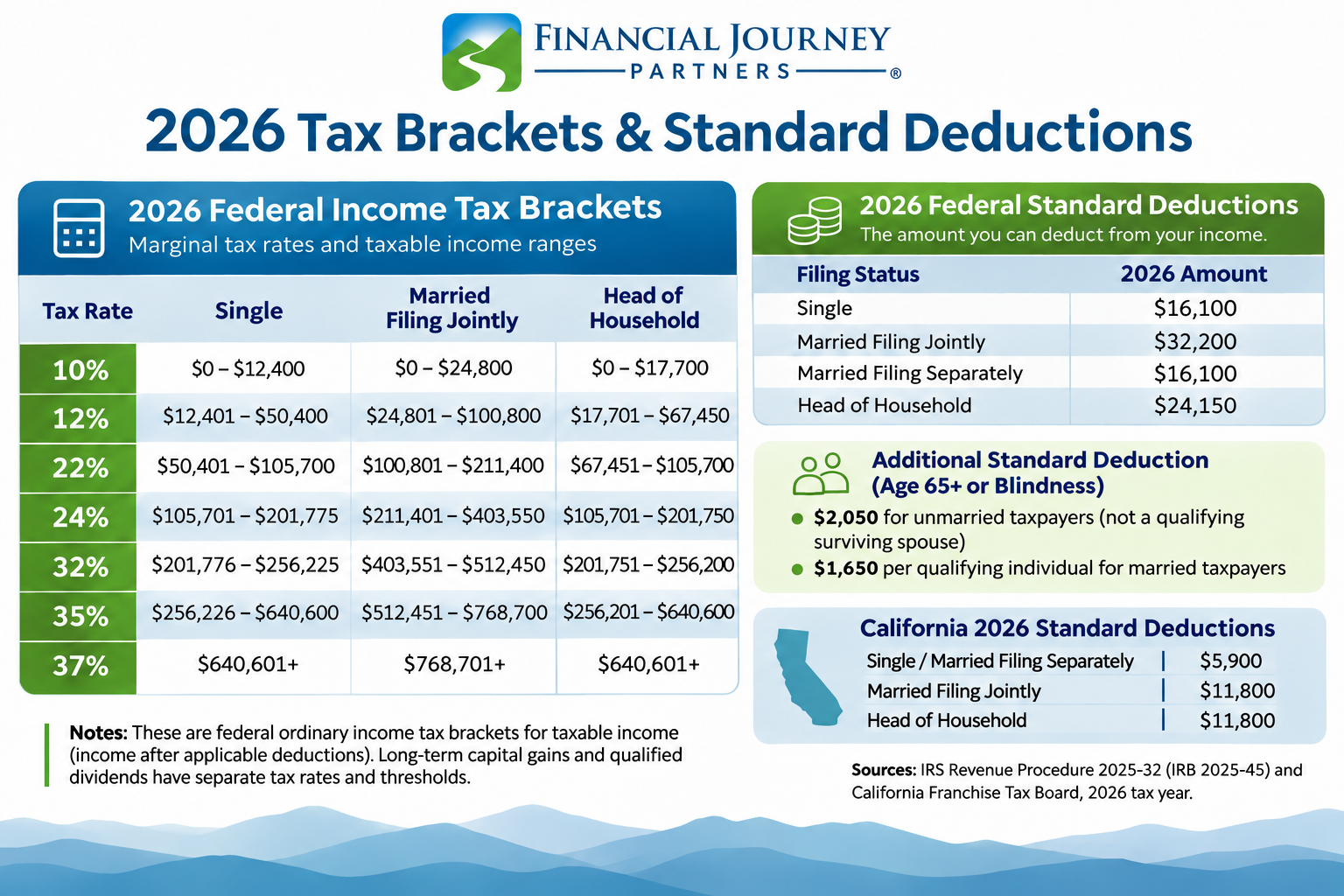
For reference, here are the 2026 federal tax brackets and standard deductions, along with California’s standard deductions. Note that the additional standard deduction for taxpayers 65 and older shown here is separate from the new $6,000 senior deduction, and eligible taxpayers can claim both.
What to do now: Ask your tax professional to run a 2026 tax projection that reflects these changes. The result tells you whether to accelerate or defer income and deductions before year-end.
Retirement Account Moves
Who it’s for: Anyone still contributing to a workplace plan, anyone 73 or older, and anyone weighing a Roth conversion.
Right-size your workplace plan contributions. For 2026, employees can contribute up to $24,500 to a 401(k), 403(b), or 457 plan. Those 50 and older can add an $8,000 catch-up contribution, and those aged 60 to 63 can add $11,250 instead. These contributions must come out of your paychecks by December 31, so check how many pay periods remain. IRA and HSA contributions for 2026 can still be made until April 15, 2027. If much of your savings already sits in pre-tax accounts, contributing the maximum may not be the best move. Your Wealth Manager can help you determine the right amount.
Take your RMDs. If you are 73 or older, your Required Minimum Distribution must be taken by December 31. A missed RMD carries a penalty of 25% of the amount not withdrawn, reduced to 10% if corrected promptly. If you inherited an IRA after 2019, you may also owe an annual distribution under the 10-year rule.
Consider a Roth conversion. A conversion is taxed this year while rates are relatively low. It can reduce your lifetime tax bill, particularly if future RMDs are likely to push you into a higher bracket. Conversions must be completed by December 31. Unlike IRA contributions, they cannot wait until April. In our experience, conversions work best when the tax is paid from non-retirement funds.
For Financial Journey Partners clients: We use advanced planning software to model whether a Roth conversion makes sense for you, both short-term and long-term. If you would like to take action, contact your Wealth Manager by early December so there is time to complete the conversion before year-end.
RSUs, ISOs, and ESPPs
Who it’s for: Anyone who receives company stock as part of their compensation, which describes many of our Silicon Valley clients.
Restricted Stock Units (RSUs). RSUs are taxed as ordinary income when they vest, whether or not you sell the shares. Employers typically withhold 22% for federal taxes (37% on supplemental wages above $1 million), which is often less than your actual tax rate. If you had large vests this year, check whether you need a fourth-quarter estimated payment, due January 15, 2027, to avoid an underpayment penalty.
RSUs also raise a preservation question. Keeping vested shares is economically the same as choosing to buy your employer’s stock with that cash. If one company’s stock has grown into a large share of your net worth, year-end is a good time to set a disciplined plan for reducing that concentration over time. If this describes your situation, let’s talk through a strategy.
Incentive Stock Options (ISOs). Exercising ISOs and holding the shares creates no regular income tax, but the difference between the exercise price and the market value counts toward the AMT. With this year’s AMT changes, many households will reach AMT with smaller exercises than in prior years. Two year-end points to consider:
- If you exercised ISOs earlier this year and the stock has since fallen, selling those shares before December 31 can eliminate the AMT exposure on that exercise. Any gain is then taxed as ordinary income, limited to what you actually realize.
- If you plan to exercise, modeling the amount that stays below your AMT threshold lets you spread exercises across tax years rather than concentrating the tax all in one year.
Employee Stock Purchase Plans (ESPPs). Shares that have been held for at least two years from the offering date and one year from the purchase date receive more favorable tax treatment. Before selling ESPP shares in December, confirm which lots qualify.
For Financial Journey Partners clients: Please share your vesting schedule and any option exercises with your Wealth Manager. We coordinate with your tax professional to model AMT and build a plan for reducing concentrated positions.
Investment and Tax-Loss Harvesting Opportunities
The opportunity: Use the year-end to manage risk and taxes together.
Tax-loss harvesting. Selling investments at a loss in a non-retirement account lets you offset capital gains realized elsewhere. Up to $3,000 of excess losses can offset ordinary income each year, and the remainder carries forward. Be mindful of the wash-sale rule: buying the same or a substantially identical investment within 30 days before or after the sale, including in an IRA or a spouse’s account, disallows the loss. We harvest losses in the accounts we manage at Fidelity. If you have losses outside our management, let us know and we can collaborate with you and your tax professional to determine what might make the most sense for you.
Rebalance with taxes in mind. Strong gains in one area can leave a portfolio carrying more risk than intended. We use year-end to review allocations and bring them back in line with your plan. Where possible, we rebalance inside IRAs and 401(k)s, where trades carry no tax consequence, and use harvested losses to offset the cost of trimming winners in taxable accounts.
Consider gain harvesting. If your 2026 taxable income falls within the 0% federal long-term capital gains bracket, realizing gains this year can raise your cost basis without any federal tax. If you fall in that bracket, it’s worth considering.
For Financial Journey Partners clients: We handle harvesting and rebalancing as part of our service. If you have sold assets at a significant gain or loss in accounts outside of Financial Journey Partners, please let your Wealth Manager know so we can factor that into your strategy.
Charitable Giving Under the 2026 Rules
Who it’s for: Anyone who gives to charity, with specific opportunities for those 70½ and older.
Qualified Charitable Distributions (QCDs). If you are 70½ or older, you can send up to $111,000 in 2026 directly from your IRA to a qualified charity. The distribution never enters your income, so the new 0.5% floor does not apply, and it counts toward your RMD if you are 73 or older. For many retirees, this is now the most tax-efficient way to give. QCDs must be completed by December 31, and because they are processed manually, we recommend requesting them no later than December 1.
Donor-Advised Funds (DAFs) and bunching. Under the new floor, giving the same amount every year leaves part of each year’s gifts without a deduction. Combining two or three years of planned giving into a single DAF contribution means the floor applies once rather than every year. It can also help you clear the standard deduction in the year you give, while you recommend grants (gifts) to your charities over time. Learn more in our blog, Charitable Giving Using a Donor-Advised Fund.
Gift appreciated stock. Donating shares held more than one year lets you deduct their full market value and avoid the capital gains tax you would owe on a sale. This pairs well with reducing a concentrated stock position, and the deduction can help offset the tax on a Roth conversion.
If you don’t itemize. The new deduction of up to $1,000 ($2,000 for married couples) applies to cash gifts made directly to operating charities. Gifts to a DAF do not qualify.
California-Specific Considerations
Many of our clients live in California, which follows its own rules in several areas. The top state rate of 13.3% makes those differences meaningful.
- No capital gains break. California taxes capital gains as ordinary income. A gain that falls in federal 0% bracket is still taxed by the state, which makes loss harvesting especially valuable for California residents.
- HSAs are not recognized. California does not allow a deduction for HSA contributions and taxes the account's earnings each year.
- California has its own AMT. ISO exercises can trigger state AMT even when the federal calculation does not. Both should be modeled before you exercise.
- Federal changes don’t carry over. The new senior deduction, the charitable deduction for non-itemizers, and the higher SALT cap are federal provisions. Your California return follows the state's own rules.
- A different estimated-payment schedule. California expects 30% estimated tax in April, 40% in June, none in September, and 30% in January. If RSU vesting or Roth conversion raised your income this year, review your January 15 state payment.
- Pass-through entity tax for business owners. If you own an S corporate or partnership, California's elective pass-through entity tax may still provide a federal deduction for state taxes above the SALT cap. Talk with your CPA about your 2026 election and payment timing.
Conclusion
Year-end planning works best with time and collaboration, not a last-minute scramble. Most of these strategies must be completed by December 31, and some, such as Roth conversions and QCDs, take time to process. Waiting until the final weeks of December leaves little room.
We partner closely with our clients’ tax professionals and are glad to help determine which strategies might fit your situation.
Financial Journey Partners clients: Contact your Wealth Manager if you have questions about these issues and want to meet before year-end to discuss them.
Not yet a client? Call us or schedule a Second Opinion complimentary consultation to learn how our Wealth Managers can help you plan for 2026 and beyond.
We are here to help you make smart decisions and align your money with your goals so you can Enjoy the Journey.

The information being provided is strictly as a courtesy. When you link to any of the websites provided here, you are leaving this website. We make no representation as to the completeness or accuracy of information provided at these websites. Nor is the company liable for any direct or indirect technical or system issues or any consequences arising out of your access to or your use of third-party technologies, websites, information, and programs made available through this website. When you access one of these websites, you are leaving our website and assume total responsibility and risk for your use of the websites you are linking to.
Investment advisory services offered through Mutual Advisors, LLC DBA Financial Journey Partners, an SEC Registered Investment Adviser. Securities offered through Mutual Securities, Inc., Member FINRA/SIPC. Mutual Securities, Inc. and Mutual Advisors, LLC are affiliated companies.