


Bonds used to be boring. But lately, they’ve been making the news.
Source: Orion Risk Intelligence as of 10/14/2026
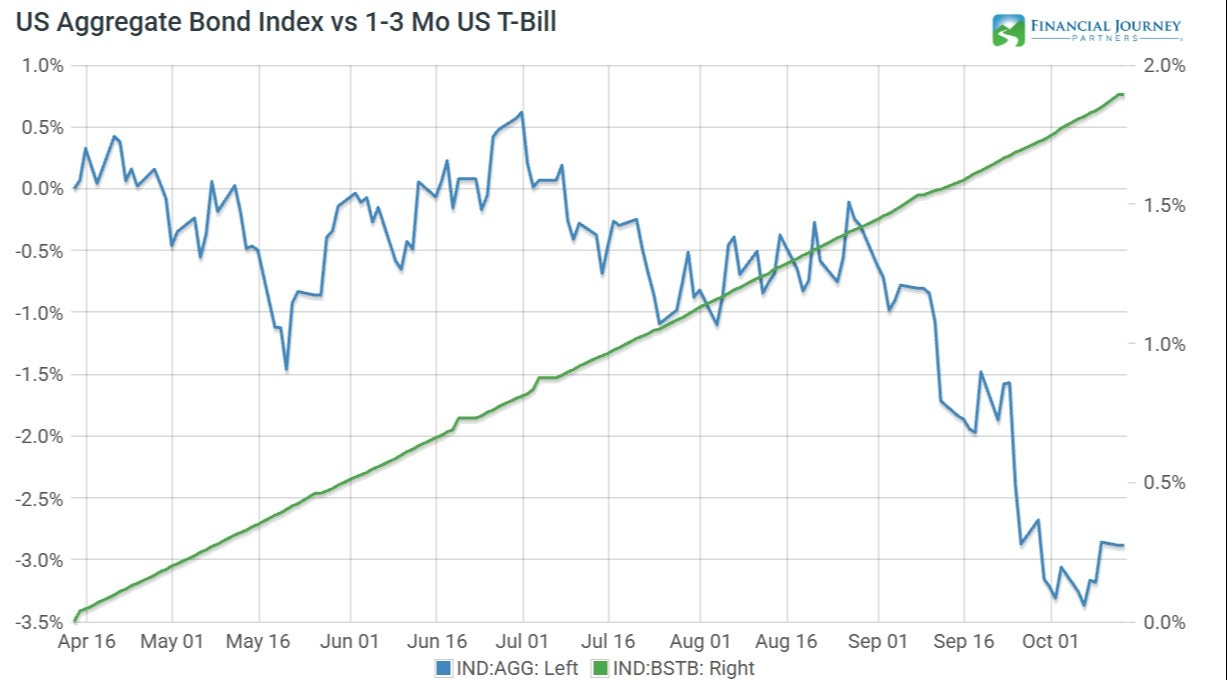
If you’ve noticed headlines about falling bond prices, you’re not imagining it. The chart above compares two indexes:
- US Aggregate Bond Index (Blue). This is an index that contains many different types of bonds and is often considered a good overall measure for the US bond market. When people talk about the US stock market, they often look at the S&P 500 as an overall measure of the US stock market. The US Aggregate Bond Index might be considered to be a similar measure of the overall US bond market. The average duration of the bonds in this index is about 5.7 years.
- 1-3 Month US Treasury Bills (Green). This is a measure of the total return (change in price plus interest) of short-term US Treasuries that have a maturity of 1-3 months.
As you can see from the graph, the US Aggregate Bond Index has been falling recently, while the 1-3 Month US Treasury Bill Index just keeps chugging along.
Sign up for our email newsletter for views of the economy, stock market, and top news stories from our Wealth Managers at Financial Journey Partners.
Why Are Longer-Term Bonds Going Down?
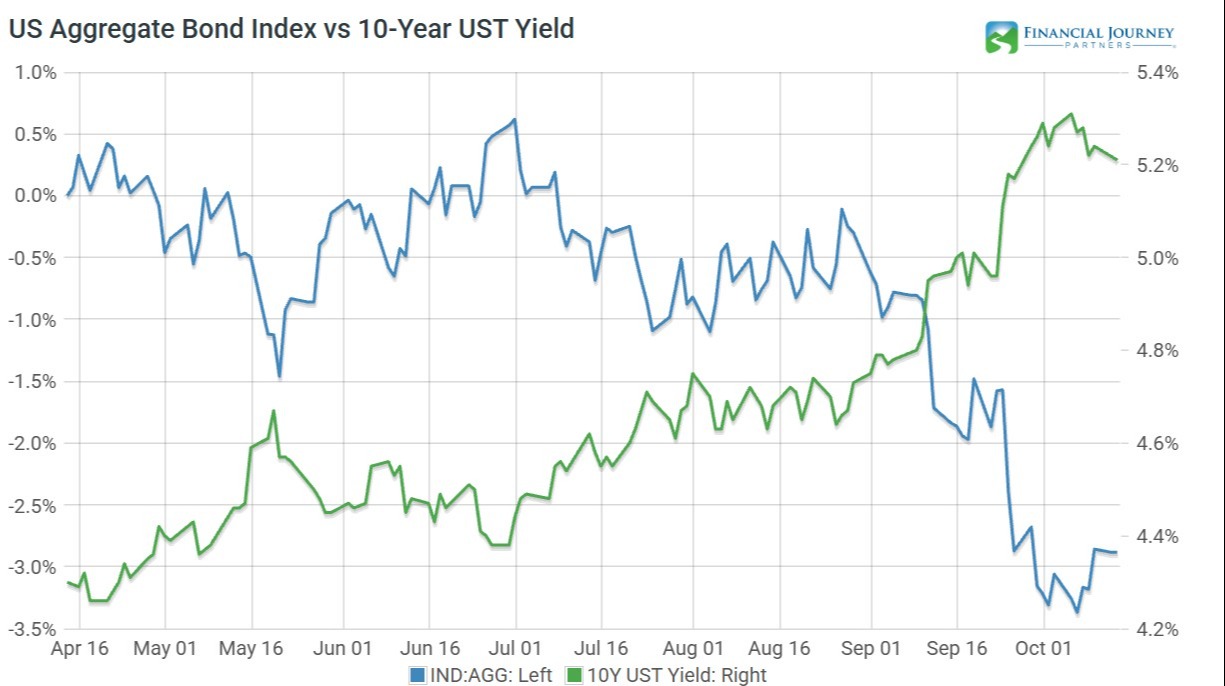
To answer this question, we have to remember that the value of bonds moves in the opposite direction of interest rates. The longer the duration of the bonds, the more sensitive their prices are to changes in interest rates. The graph below shows this well.
Source: Orion Risk Intelligence as of 10/1/2026
The chart above compares the US Aggregate Bond Index (Blue) to the 10-Year Treasury Yield (Green). You can see they are a mirror image of each other.
The chart shows that interest rates have been rising in the past six months. Why is that?
- The war in Iran has been driving up oil prices in the last six months
- Rising oil prices have been pushing up inflation
- In September, the Federal Reserve raised short-term interest rates for the first time in more than three years. The goal is to keep inflation from climbing further and, ideally, to begin bringing it back down. Since then, longer-term rates have actually risen more than short-term rates. That isn't simply a direct result of the Fed's move. It reflects bond investors demanding higher yields to compensate for the risk that inflation stays elevated.
There are mixed opinions among analysts about whether the Federal Reserve will need to raise interest rates again this year.
What Did FJP Do About This?
At Financial Journey Partners, we are active money managers. As markets change, we adjust our clients’ investments to participate when markets are rising and to help protect their assets when markets are falling. For the past couple of years, the Fed was lowering short-term rates and bond funds like the US Aggregate Bond Index were producing positive returns.
But in the past six months, longer-term interest rates reversed and started going up. About five months ago, we saw inflation starting to rise and concluded that interest rates were likely to follow. Rising rates are bad for longer-term bonds, so we moved our clients’ bond holdings from funds similar to the US Aggregate Bond Index into shorter-term bond funds. Those funds have performed much like the 1-3 Month US Treasury Bill Index shown above.
We made a similar move for clients in 2022. If you remember, 2022 was the worst year on record for the US bond market, with the US Aggregate Bond Index falling 13%. Early in 2022, short-term interest rates were near zero and inflation was running at its highest level in 40 years and still climbing. It eventually peaked above 9%. We could see that interest rates were likely to rise sharply, which would be very bad for bonds. So, we sold our clients’ bond holdings and moved that money into money market funds, which are designed to maintain a stable value. The money market funds held up well throughout 2022.
Summary
At Financial Journey Partners, our Investment Team does the direct asset management for all our client accounts. We have managed investments for decades, through challenging times like the dotcom bust, the Great Financial Crisis, and the COVID-19 pandemic. We are active investment managers who will adjust the investments in client accounts based on the conditions in the stock and bond markets.
If you have questions about the economy, the markets, or your portfolio, please give your Wealth Manager a call. We’re always happy to talk, so you can focus on enjoying the journey.

The information being provided is strictly as a courtesy. When you link to any of the websites provided here, you are leaving this website. We make no representation as to the completeness or accuracy of information provided at these websites. Nor is the company liable for any direct or indirect technical or system issues or any consequences arising out of your access to or your use of third-party technologies, websites, information, and programs made available through this website. When you access one of these websites, you are leaving our website and assume total responsibility and risk for your use of the websites you are linking to.
Investment advisory services offered through Mutual Advisors, LLC DBA Financial Journey Partners, an SEC Registered Investment Adviser. Securities offered through Mutual Securities, Inc., Member FINRA/SIPC. Mutual Securities, Inc. and Mutual Advisors, LLC are affiliated companies.