


One of the things we value most is hearing from our clients. With the recent conflict in Iran and increased stock market volatility, we’ve been getting a lot of great questions about how we manage investments. We thought this would be a good time to share an update on our investment process, which is designed to navigate a range of market conditions.
At Financial Journey Partners , we directly manage the investments in your portfolio. That means our team decides which investments to use, and when to buy or sell them, on an active and discretionary basis. We are not a buy-and-hold firm. When we see opportunity, we pursue it. When caution is warranted, we act on that too. Discretionary management means we can make these moves on your behalf without waiting to contact you first, enabling us to respond quickly when markets demand it.
We are proud of the work we do managing our clients’ investments, and we want to share our process with you.
In this month’s blog, we will discuss:
In this blog, we will discuss the following:
- The Evolving U.S. Stock Market
- The Role of New Technology
- Stock and Bond Market Volatility
- Understanding Each Client's Risk Tolerance
- How We Actively Manage Investments
- How We Select Investments
- Back Testing and Forward Stress Testing
- Conclusion
Sign up for our email newsletter for views of the economy, stock market, and top news stories from our Wealth Managers at Financial Journey Partners.
The Evolving U.S. Stock Market
The U.S. stock market has changed dramatically over the past 25 years, and how investors trade within it has changed along with it. One of the most significant shifts has been the migration of money away from mutual funds and into Exchange Traded Funds (ETFs) — and it’s a shift that has worked in your favor.
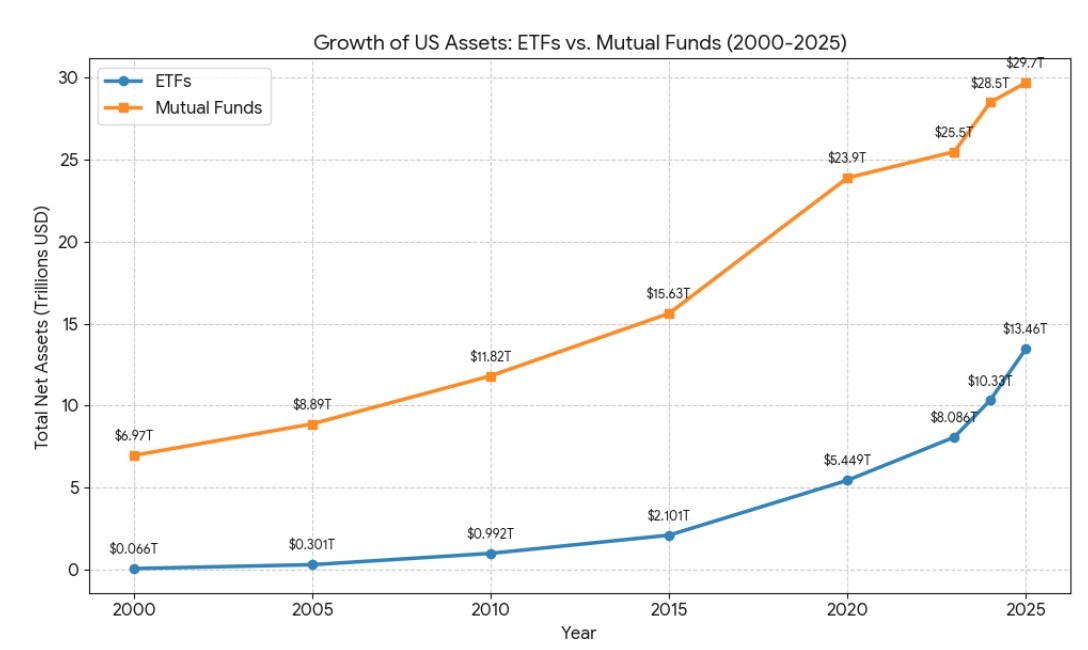
Source: Investment Company Institute (ICI)
The transition from mutual funds to exchange traded funds has accelerated in the past 10 years.
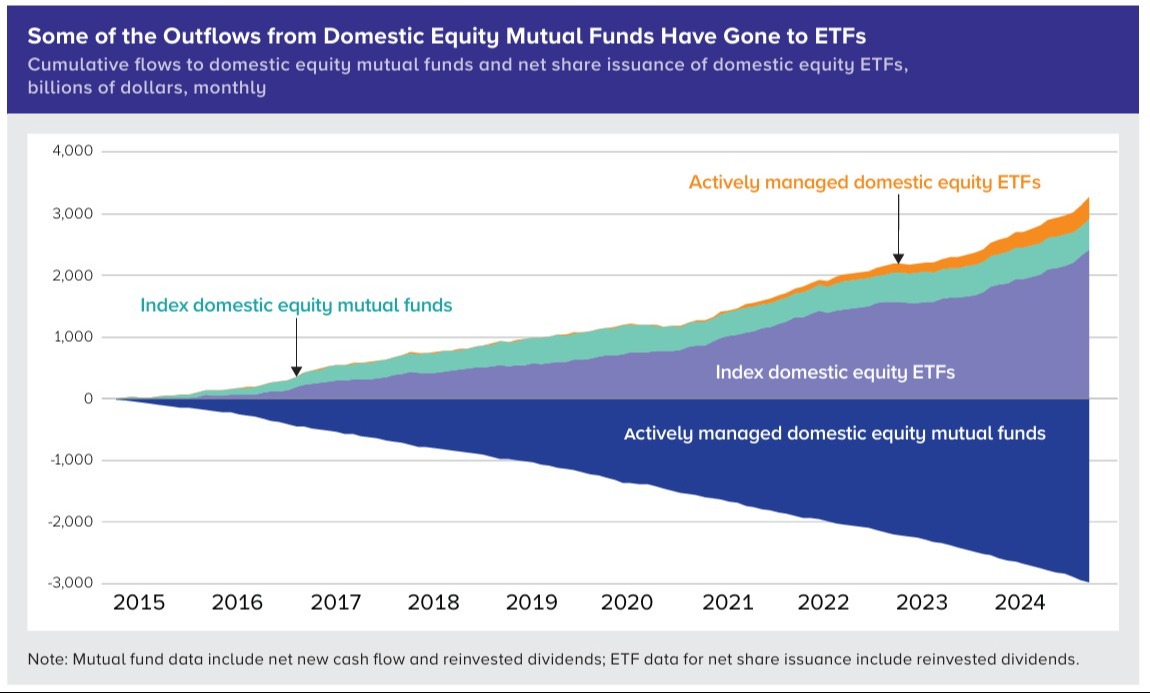
Source: Investment Company Institute (ICI)
Mutual funds can only be traded at the end of the trading day, and many carry short-term redemption fees if sold within one to three months. ETFs, by contrast, trade throughout the day like individual stocks and carry no such restrictions. This flexibility has made ETFs the vehicle of choice for professional managers who need to act quickly, and in many cases, ETFs also carry lower internal expenses than comparable mutual funds.
The Role of New Technology
Technology has also reshaped how investment managers execute trades on behalf of clients. One important example: regulators strongly encourage the use of block trading, a practice designed to ensure all clients receive the same, best possible price when we buy or sell a security.
Here is how it works:
- We determine the number of shares to purchase for each eligible client account
- We add those shares together to create a single "block" order
- That block is executed on the exchange (NYSE or Nasdaq) at the best available price
- Once filled, shares are distributed proportionately across all client accounts
At FJP, we execute block trades through our custodian, Fidelity, working directly with their trading desk to secure the best possible execution price at the exchange. This process keeps trading fair, efficient, and cost-effective for every client — because every client deserves the same quality of execution, regardless of account size.
Stock and Bond Market Volatility
We know market volatility can be unsettling. But here’s some important context: markets don’t move in a straight line, and that’s normal. On any given day, the U.S. stock market can swing 1–2% or more. Over the course of a year, 5–10% pullbacks are common. What matters is understanding how to navigate those swings thoughtfully.
Over the past decade, there have been a handful of more significant market dislocations, periods where stocks fell 20% or more:
- 2020: The COVID-19 pandemic triggered a sharp global market sell off
- 2022: The Federal Reserve raised interest rates from near zero to 5.25% to combat inflation, pressuring stocks and bond
- 2025: The Trump Administration implemented tariffs on countries around the world, creating uncertainty and market volatility
In each of these cases, the market recovered to new all-time highs within 12 months of its lows. Most recently, the S&P 500 reached a new all-time high in January 2026. History doesn’t repeat exactly, but it does remind us why staying disciplined through difficult periods has mattered.
Bonds can be volatile too. The 2022 rate-hiking cycle produced the worst year for bond returns in over a century: many bond funds lost 15% or more. In early 2022, we temporarily sold all bond funds in client portfolios to protect them from that drawdown.
Understanding Each Client's Risk Tolerance
Here’s something we’ve learned after decades of working with clients: no two clients are alike. Some of you are focused on preserving wealth; others are comfortable with more volatility in pursuit of growth. Our job is to understand where you stand and build a portfolio that reflects that.
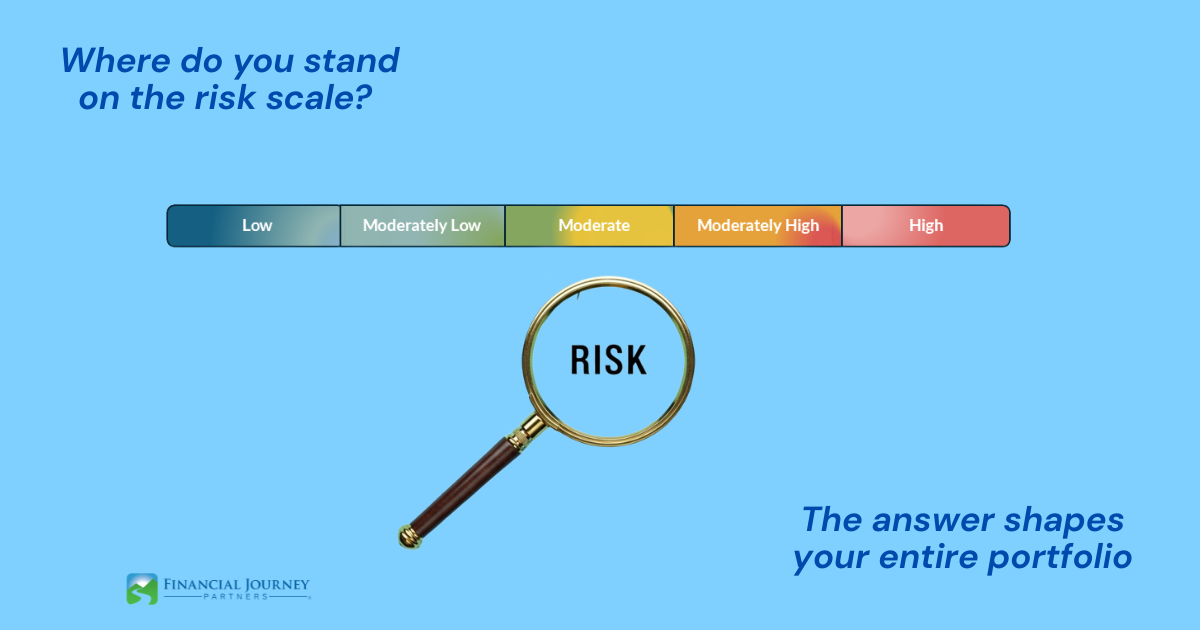
Every new client starts with a 10-question risk survey, which helps us understand your comfort level with market swings. We maintain five model portfolios ranging from conservative to aggressive, and your Wealth Manager works with you to select the one that fits your goals and temperament. As your life changes, and as the market evolves, we revisit your risk profile and adjust your portfolio accordingly.
How We Actively Manage Investments
With decades of investing experience, our team has guided clients through some of the most turbulent markets in history: the Dotcom bubble, the Great Financial Crisis, and the COVID-19 pandemic, each of which saw the U.S. stock market fall by as much as 50%. Those were difficult times for everyone. Through all of it, our clients have told us the same thing: they want us to help protect the wealth they've accumulated, not just ride the market up and down.
That's what active, discretionary management means in practice. We increase equity exposure when we're confident in the market's direction. We raise cash or shift to more defensive positions when we see warning signs. And we do this proactively, without waiting to call you before making a move, because in fast-moving markets, timing matters as much as the decision itself.
The reality is that investing involves risk, and your portfolio can and may lose value during market corrections. Our goal is to minimize the damage during those periods, but we cannot eliminate it entirely. We work hard to smooth out the ride, but all markets move up and down — that's the nature of investing. If the idea of any loss concerns you, that's an important conversation to have with your Wealth Manager. Avoiding risk entirely is possible, but it significantly limits your investment options. We're here to help you find the right balance.
How We Select Investments
Choosing the right investments starts with deep research: into the economy, the broader market, and the individual securities we're considering. We don’t do this alone. We partner with some of the world's leading investment managers (including BlackRock, Fidelity, Vanguard, Invesco, Goldman Sachs, PIMCO, and Guggenheim), which gives us access to institutional-grade research and analytics that most individual investors simply don’t have.
All the investments we use (ETFs, mutual funds, and individual stocks) are highly liquid and traded on U.S. exchanges. When evaluating an ETF or fund, we look at factors including the size of the fund, its investment objective, growth potential, and internal expense ratios. While low fees matter, our primary goal is to find investments that align with our clients’ risk tolerance.
We also follow a select group of independent market analysts, which helps us stress-test our thinking and identify opportunities we might otherwise miss.
Back Testing and Forward Stress Testing
We use tools that enable us to back test and “stress” test our portfolios. We use these to help clarify how investments might perform under various market conditions. We think of it as doing our homework before the bell rings.

FJP Investment team: Flavio Pando Jr., Ben Manley, Scott Manley, Elaine Manley, Linda Tjiputra
Back-testing allows us to see how a portfolio would have performed through past market environments: bull markets, recessions, rate cycles, and crashes. Forward stress testing lets us model how a portfolio might hold up under a range of possible future scenarios. We use industry-leading tools and analytics from our institutional partners to conduct this analysis.
Of course, past performance is no guarantee of future results, as we always acknowledge. But rigorous testing gives us much greater confidence that our portfolios are built to perform across a wide range of conditions, not just the last few years.
Our two analysts and traders, Flavio Pando Jr. and Ben Manley, monitor all model portfolios on a weekly basis. Beyond that, our full investment team of five meets three to five times per week to review the economy, assess market conditions, and make any necessary adjustments to client portfolios. When markets move, we’re already at the table.
Conclusion
We want you to feel confident that your portfolio is being watched by people who know you, understand your goals, and have the experience to act decisively when it matters.
Our goal is to capture market growth when conditions are favorable, and to protect your wealth when they're not. We tailor every portfolio to the individual, and we adjust as your circumstances and the market change.
Most importantly, we want you to have peace of mind, so you can leave the market watching to us so you can Enjoy the Journey.
If you are a client of FJP and have questions about the U.S. economy, the U.S. stock market, or your portfolio, contact your Wealth Manager, Elaine Manley, Scott Manley, Linda Tjiputra, we love hearing from you and are happy to talk.

References:
1Bureau of Labor Statistics – December 2024 Report
2Bureau of Labor Statistics – December 2024 Report
3TradeEconomics.com – U.S. Fed Funds Interest Rate
4Bureau of Economic Analysis – GDP, Corporate Profits Q3, 2024
5Federal Reserve Bank of St. Louis – Federal Surplus/Deficit
The information being provided is strictly as a courtesy. When you link to any of the websites provided here, you are leaving this website. We make no representation as to the completeness or accuracy of information provided at these websites. Nor is the company liable for any direct or indirect technical or system issues or any consequences arising out of your access to or your use of third-party technologies, websites, information, and programs made available through this website. When you access one of these websites, you are leaving our website and assume total responsibility and risk for your use of the websites you are linking to.
Investment advisory services offered through Mutual Advisors, LLC DBA Financial Journey Partners, an SEC Registered Investment Adviser. Securities offered through Mutual Securities, Inc., Member FINRA/SIPC. Mutual Securities, Inc. and Mutual Advisors, LLC are affiliated companies.